
During the Great Depression, people used to say "times is tough." A lot of small business owners may be feeling that way these days as they face headwinds from multiple directions: tariffs, out-of-control oil prices, economic uncertainty, and more.
Doing business the same way you did it even five years ago is risky, particularly for small businesses. You can't afford to be overstaffed or understaffed. You can't have product sitting around without being sold or used. And you can't afford to pay people to do things that don't need people to do.
All of these challenges are leading small business owners to suffer from decision fatigue. Every decision is rife with risks, and relying on gut instincts to make the right call places a ton of pressure on you. So what's the alternative? It turns out that there are some great choices if you're willing to escape your comfort zone a little and do something different.
How have small-business headwinds changed over the last few years?
Inflation is up, oil prices are through the roof, demand is fickle, and tariffs keep moving. According to the latest MetLife & U.S. Chamber Small Business Index (April 2026), 53% of small business owners name inflation as their top concern, and it's been the leading concern awhile now.
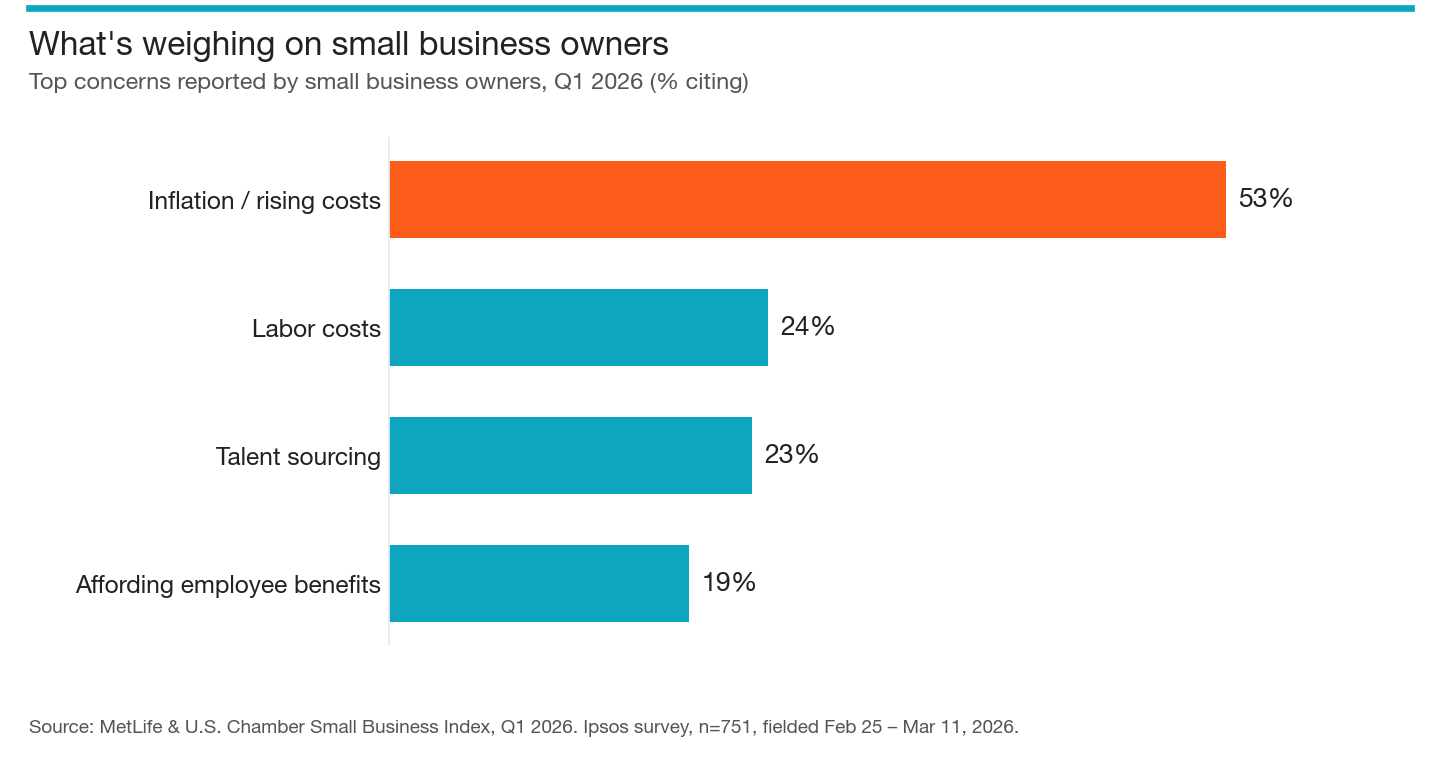
Small businesses can't do things the old way anymore.
We completely remodeled our house 10 years ago, and everything was new and shiny. Now it's 10 years later and the floors are beginning to look a little shopworn, the range doesn't get as hot, some repainting is in order, etc. That's part of the reason why people remodel so often when they buy new houses.
The same can be true of your business. You may know it really well, but comfort can easily lead to complacency, and wear can start showing up subtly in the numbers. That's a risk, especially when the variables change like they are now. Before those subtle trends turn into a crisis, it's time to start considering some business remodeling. Here are three key ways to do it:
- Use data better (Information)
- Rethink old processes (Automation)
- Start doing new things (Innovation)
These are three simple concepts, but they require you to adopt approaches you may not have used before.
Use data better.
Most small businesses are sitting on information that could change how they make decisions, and barely using any of it. Sales records, customer counts, scheduling history, accounting entries, booking patterns — all of it lives in one system or another, untouched between the moment it was collected and the next monthly meeting where someone tries to remember what happened. Smart businesses are putting that information to work in service of foundational questions: which products carry the margin, which days drive the revenue, which customers come back and which don't, where the staffing is mismatched against the demand.
There is also a category of information that lives outside the business and is more useful than most owners realize. Weather data explains a surprising amount of what looks random in retail and hospitality. Local event calendars can have an impact that might be memorable at the time but don't always transfer from short- to long-term memory. Demographic shifts in your buyers may show up in receipts before the trend is obvious. Competitive information — pricing, hours, reviews — is publicly available for anyone willing to gather it. None of this requires you to revolutionize your business processes; rather, it requires a decision to look deeper into the numbers that have been sitting in plain sight.
What's also new is the way the conversation between you and your data has changed. You should be able to ask a question in plain language (or a few clicks) and get an answer back without needing to know data science. That removes the last technical barrier between you and the answers your business may have been sitting on for years. The technology is there, with myriad tools to mine your data, and people like me who can help you use it.
Rethink old processes.
Take inventory of what gets done the same way every week, every month, every quarter: the reports that get rerun or rebuilt from scratch, the reminders that get sent, the invoices that go out, the past-due balances that need collection, the schedules assembled from the same inputs. These can be time-consuming, monotonous, and even uncomfortable, but they just keep happening the same way because they're "the way we run the place."
What's different now is that the technology to handle most of it has caught up. AI and the surrounding tools can act as agents on your behalf to do the repetitive work using the rules you've internalized for years: schedules, triggers, etc. These tools can pick up an enormous amount of labor-intensive work that's monotonous, expensive, and predictable. Invoices go out on time without anyone clicking send. Overdue balances surface with the right tone of follow-up, on the right schedule, in the right channel. Inventory gets reordered when the patterns say it's time and before you have empty shelves. None of this removes you from making decisions, but it does remove you (or someone who works for you) from doing rules-based tasks that don't require you to approve each iteration.
Start doing new things.
You probably have a wishlist of things you would love to do if you had time — a stronger social presence, a website that reflects the business better, events that bring customers in, a newsletter, a more functional loyalty program. The list grows longer but often doesn't get touched because the people who could do the work are already doing their existing jobs, and you can't afford to hire a person or an agency to do the work for you.
That equation has changed. You can orchestrate an AI agent to create a top-notch website and even update it with new content automatically — keeping you as involved as you want to be by providing judgment in the moments that matter. It can plan, coordinate, and schedule the moving parts of an event, from the invite list to the timeline to the follow-ups. It can run as a working social media partner — proposing posts, drafting captions, scheduling the calendar, tracking what landed — and produce great results. The same goes for newsletters, loyalty programs, customer outreach, and most of the other items that have been sitting on that list for too long.
That's not to say that setting up an AI agent is simply a "set it and forget it" exercise. Getting the right process, words, graphics, formatting, and so on takes time and patience. Working with AI agents takes a cadence, an understanding of which AI tools are best for the project at hand, and (very important) a strong feel for their limitations. But ultimately you'll spend way less time (and money) than alternatives — and with results that will impress.
Can non-technical small businesses do all this?
Yes. The bar to entry on these tools has dropped further and faster than most people realize. Five years ago, getting any of this to work required a real technical skill set — query languages, scripting, and infrastructure. Today, the interface to most AIs involves a conversation in plain language. You describe what you want; the tool figures out how to do it, and you iterate on the result until you're satisfied. The skill that matters now is being able to articulate a clear question or instruction and managing how the AI stores and uses what you feed it.
I know that lots of people see AI as daunting and even scary. As a small business owner, it requires willingness for you to do something different in an operation you have already figured out how to run. That's a real ask, especially in a year when the headwinds are giving small businesses lots of reasons to keep their head down and stick with what's known. But the gap between the businesses that adopt these tools and the ones that don't is going to widen quickly, and the cost of waiting isn't symmetrical with the cost of moving. Moving early is a learning curve. Waiting is a competitive disadvantage that compounds.
Where Island Analytics fits
Island Analytics exists to help small business owners do exactly what this piece prescribes. We focus on the same three areas:
- Information: Making your existing information work for you, surfacing the questions you've been guessing at and replacing the guesses with answers.
- Automation: Rebuilding the processes that have accumulated over the years, automating the repetitive parts and keeping people on what only people can do.
- Innovation: Taking the things that have been sitting on the "someday" list and finally doing them, using the tools that have made them feasible for businesses our size for the first time.
I started the company because I was running into all three of these problems in my own businesses (that story is here), and what I found available in the market either wasn't built for small businesses or required more technical lift than any of us had time for. So I built what I wanted as a customer. The clients I'm talking with now are seeing the same things I saw — and getting their hours, their margins, and their forward momentum back.